PestHarbor Pest ControlPestHarbor Pest Control

Mosquito Habitat Suppression & Larvicide Application Cary

Mosquito colonization across Wake County is largely driven by localized micro-habitats rather than open airspace. Properties in established, heavily wooded developments such as Preston, Lochmere, and MacGregor Downs…
Get My Free Estimate →(984) 306-0048
Mosquito Habitat Suppression & Larvicide Application in Cary, NC
Quick answer
  • Includes physical water-reservoir mitigation, gutter drainage evaluation, and targeted EPA-registered biological larvicide distribution.
  • Initial diagnostic inspections and treatments generally complete within 60 to 90 minutes across an average half-acre lot.
  • Ballpark pricing begins at a $250 minimum service fee, with final totals confirmed on-site based on property acreage and water retention points.
  • Treatments neutralize Culex, Aedes aegypti, and Aedes albopictus (Asian Tiger) mosquito larvae without disrupting non-target wildlife.
  • Direct service arrangements are scheduled through (984) 306-0048 with no recurring subscription mandates.

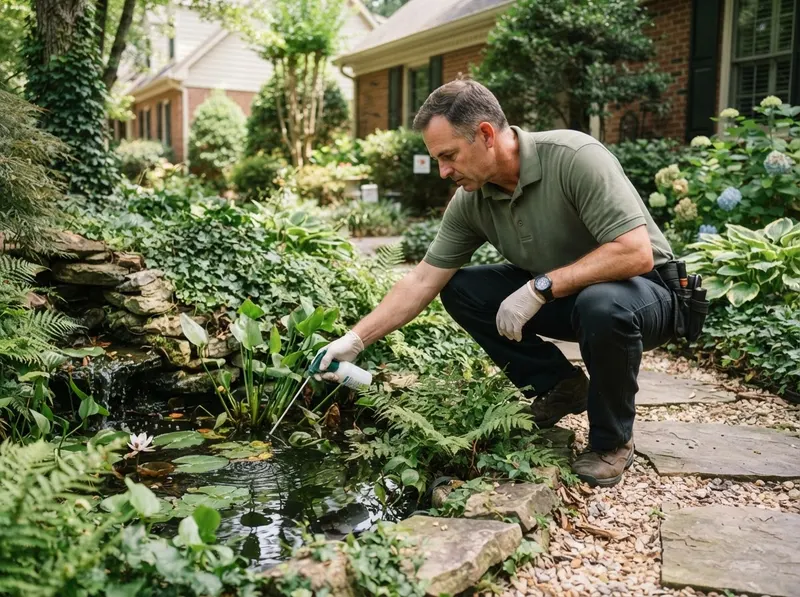
Mosquito colonization across Wake County is largely driven by localized micro-habitats rather than open airspace. Properties in established, heavily wooded developments such as Preston, Lochmere, and MacGregor Downs frequently collect natural moisture in low-lying grade depressions, mature tree cavities, and ground-level stormwater basins. When outdoor temperatures consistently exceed 50 degrees Fahrenheit, female mosquitoes deposit between 100 and 200 eggs at a time in stagnant film. Rather than saturating yards with indiscriminate adulticide thermal fog that disperses quickly and affects pollinators, targeted larvicide application disrupts the insect's life cycle at the instars stage. Biological agents such as Bacillus thuringiensis israelensis (BTI) introduce crystalline proteins that specifically disrupt mosquito digestive systems, leaving pets, beneficial insects, and soil ecosystems completely unharmed.

Dense community layouts and managed drainage systems in neighborhoods like Amberly, Wellsley, Twin Lakes, and Carpenter Village face distinct biological pressure points. Architectural features such as corrugated catch-basin extenders, landscape tiering, and clogged gutter transitions hold small volumes of stagnant water for over 72 hours, the minimum period necessary for larvae to reach adulthood. Properties bordering riparian buffer zones near Fred G. Metro Bond Park, Downtown Cary Park, or the tributary streams surrounding Koka Booth Amphitheatre experience consistent atmospheric humidity that shields adult insects in deep turf foliage. Effective intervention targets these specific structural reservoirs rather than applying broad retail aerosol treatments that fail to penetrate root barriers.

Property owners evaluating abatement options must weigh adult knockdown treatments against comprehensive larval suppression. Surface fogging provides immediate adult mortality for 24 to 72 hours but leaves millions of submerged eggs intact, resulting in re-infestation within days. Conversely, targeted habitat suppression with micro-pellet or briquette formulations sustains protection for up to 30 days per site by continually releasing active spores throughout the entire aquatic layer. While this protocol requires physically locating cryptic pooling areas beneath crawlspaces, deck undersides, and decorative planters, it reliably halts generational breeding cycles without requiring aggressive chemical saturation.

Mosquito Habitat Suppression & Larvicide Application cost in Cary

Standard Quarter-Acre Lot Treatment$250 - $325
Half-Acre to Full-Acre Residential Parcel$325 - $450
Dense Riparian or Pond-Adjacent Boundary Acreage$450 - $650
Drainage & French Drain Biological Remediation Add-on$250 minimum baseline

Every job gets a firm, written price after a free on-site visit.

Common questions

How does professional larvicide differ from retail yard sprays in Cary?
Retail adulticide yard sprays use synthetic pyrethroids that temporarily knock down flying insects without neutralizing larvae living underwater. Professional biological larvicides specifically prevent aquatic larvae from maturing into breeding adults, providing residual control for weeks rather than hours.
Are biological mosquito treatments safe for children and domestic pets in Cary?
Biological control treatments using BTI are strictly toxic to dipteran insect larvae and do not affect humans, mammals, fish, honeybees, or wild birds. Treated yards and ornamental features remain accessible immediately following application.
How quickly do mosquito larvae die after application on a Cary property?
Active biological larvicides begin destroying the cellular lining of larval intestines upon ingestion, resulting in complete larval mortality within 24 to 48 hours of dispersion across standing water surfaces.
Are quarterly contracts required for mosquito control in Cary?
Single targeted applications are performed as autonomous interventions based on specific biological needs rather than binding automatic quarterly agreements. Service quotes adhere strictly to the established $250 minimum threshold.
What standing water sources on Cary properties breed the most mosquitoes?
Underground corrugated drainage pipes, bird baths, landscape collection saucers, and flat gutter transitions around residential structures represent the primary sources for domestic mosquito breeding cycles.
Helpful resources

Trusted references & local links

USA.gov, government & consumer helpBetter Business BureauFTC Consumer AdviceU.S. Small Business AdministrationReady.govU.S. EPAENERGY STARU.S. Dept. of EnergyConsumer.govU.S. Census BureauGoogle Maps, Cary, NC

Get started today

Tell us about your mosquito habitat suppression & larvicide application job in Cary and we'll send a clear, written quote, usually the same day.
Get your free Pest Control Service quote, Cary

We only use your ZIP to check availability, no spam.